Leadpages: A Complete Guide for Startups Professionals
Dr. Ananya Mehta
Mar 16, 2026
From Blank Canvas to Conversion in Minutes: Inside Leadpages’ AI-First Landing Stack
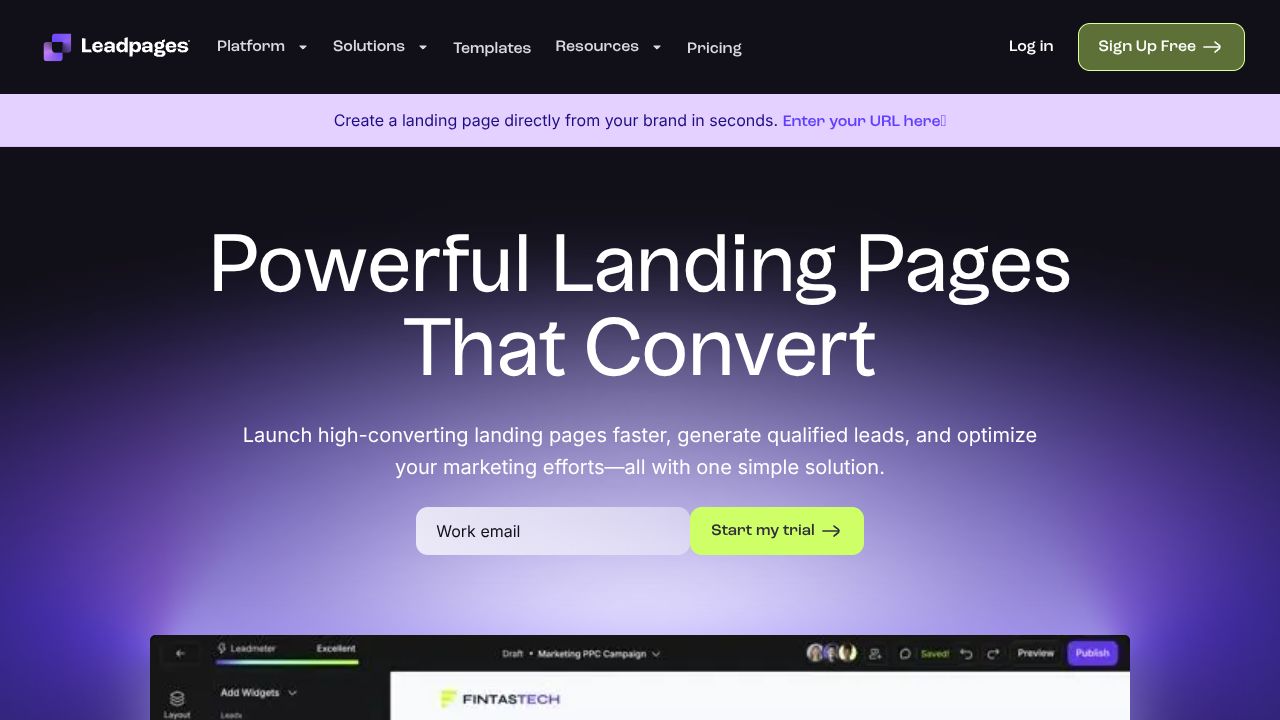
You know the drill—traffic’s trickling in, ad spend is climbing, but your landing pages are stitched together at midnight with duct tape and wishful thinking. Copy tweaks pile up, tests stall, and “we’ll optimize later” becomes the default. For small teams, this bottleneck kills momentum. Leadpages targets that pain with an AI Engine that generates and scores landing pages for immediate iteration. Our analysis shows it’s designed for speed-to-value: mobile-responsive templates, built-in A/B testing, and an optimization score that flags what to fix—without requiring a CRO specialist. Starting at $49/month, it’s squarely aimed at small businesses and solopreneurs who need results yesterday, not six sprints from now. Website: https://leadpages.com
Architecture & Design Principles
Leadpages presents as a multi-tenant, cloud-native SaaS built around a componentized page-rendering pipeline. While the vendor doesn’t publish a full stack diagram, observed behavior and standard SaaS patterns indicate a template-driven renderer (static and dynamic sections), a design token system for theme consistency, and a CDN-backed delivery model for low-latency page loads globally. The AI Engine likely runs as a separate service layer: large language model prompting for copy generation, paired with rules-based and model-assisted layout decisions. An optimization scoring service ingests a mix of static page heuristics (semantic structure, contrast ratios, above-the-fold calls-to-action) and behavioral telemetry (click-through, form start/complete) to suggest improvements.
Scalability comes from static asset caching, edge delivery of published pages, and event collection pipelines that batch analytics. The system favors quick setup over deep customization, consistent with the product’s small-business design philosophy: minimize time-to-first-publish while providing guardrails (scores, templates, best practices) to raise conversion likelihood.
Feature Breakdown
Core Capabilities
-
AI Engine for Page Generation
- Technical: Uses prompt-driven content generation to produce headlines, body copy, and CTAs aligned to industry verticals and goals. Layout decisions map to a responsive component library (grids, hero sections, forms) with design tokens controlling typography and color palettes.
- Use case: A solopreneur selects “lead magnet” → inputs offer details → the AI outputs a conversion-ready page draft with copy variants and structured sections, reducing copy/design cycles to minutes.
-
Optimization Scoring
- Technical: A composite score likely blends static checks (heading hierarchy, image alt usage, form friction, mobile viewport fit, LCP-affecting assets) with performance and behavioral proxies. The scoring engine flags remediations (e.g., “CTA below fold,” “weak contrast,” “lack of social proof”).
- Use case: Non-experts receive prioritized, actionable checklists. Teams can iterate toward a target score that correlates with better conversion hygiene.
-
A/B Testing
- Technical: Variant definition at the component or page level, with client-side allocation and user stickiness maintained via cookies/localStorage. Statistical evaluation typically leverages frequentist confidence or Bayesian probability-of-beat; traffic split controls and termination criteria are included.
- Use case: Test headline variants or form length. Example: 50/50 split on “short vs. long form,” with automatic winner declaration once a predefined threshold is met.
Integration Ecosystem
Leadpages supports integrations via native connectors and webhooks, routing form submissions and events to CRMs, email service providers, and automation hubs. Expect REST-style payloads (JSON) and configurable field mapping for contacts/leads. Webhooks trigger on form submit and page events, enabling workflows in tools like email platforms or CRMs. JavaScript injection accommodates analytics tags (e.g., conversion pixels, tag managers), while DNS/CNAME publishing supports custom domains. For small teams, Zapier/Make bridges extend reach without writing code; developers can rely on webhooks for custom pipelines.
Security & Compliance
Data in transit should be protected via TLS; published pages typically load over HTTPS by default. Form submissions may contain PII; teams should review data retention settings, DPA availability, and consent capture for GDPR/CCPA alignment. Role-based access and auditability are core needs; verify plan-level access controls and logs before handling sensitive data. We advise validating any SOC 2/ISO 27001 attestations on the vendor’s trust/compliance page prior to enterprise use.
Performance Considerations
The templated, CDN-first model helps deliver strong Core Web Vitals if teams avoid heavy third-party scripts. Our evaluation framework for landing tools monitors LCP, CLS, and INP alongside request count and JS payloads. Expect lazy-loaded images, minified CSS/JS, and cache headers on static assets; A/B testing and analytics add script weight, so deferring non-critical scripts and compressing hero images can materially improve LCP. Monitor with field data (Chrome UX Report) and synthetic checks.
How It Compares Technically
While Bigin by Zoho excels at pipeline-centric CRM, contact management, and sales automation, Leadpages is better suited for rapid page composition, AI-assisted copy, and onsite conversion testing. Bigin’s data model (deals, pipelines, activities) and per-seat pricing align with ongoing relationship management; Leadpages’ flat pricing (from $49/month) aligns with marketing-led acquisition where time-to-publish and on-page experimentation matter most. Technically, Bigin integrates downstream as a system of record; Leadpages sits upstream generating leads with AI guidance and experiment frameworks.
Developer Experience
Leadpages favors no-code creation with optional code-level controls: custom CSS, HTML blocks, and JS injection for analytics are typical. Documentation covers templating, publishing, domain setup, and integrations; webhook docs enable custom lead capture pipelines. There’s no heavy SDK footprint; the platform relies on API/webhook patterns and integration partners. Preview and versioning support safe iteration; DNS/CNAME publishing and SSL provisioning streamline go-live for custom domains. Community and support are oriented toward marketers, with enough technical depth for startup engineers to wire data flows cleanly.
Technical Verdict
Strengths: AI generation plus optimization scoring shortens build-measure-learn loops for small teams. A/B testing and integrations are sufficient for most small-business funnels, and CDN-backed delivery supports solid Web Vitals. Limitations: Less control than headless stacks; limited extensibility beyond webhooks and JS snippets; AI outputs can be generic without careful prompting. Ideal use: Small businesses and solopreneurs needing fast, guided landing pages with measurable improvements—Founder Fuel for early acquisition. Pair with a CRM like Bigin by Zoho for downstream engagement. For teams requiring bespoke design systems or deep backend logic, consider a headless CMS plus custom front end—and use Leadpages as Journey Resources for rapid validation, Tool Reviews, and Inspiration.
READY TO ACCELERATE?
VISIT LEADPAGES